
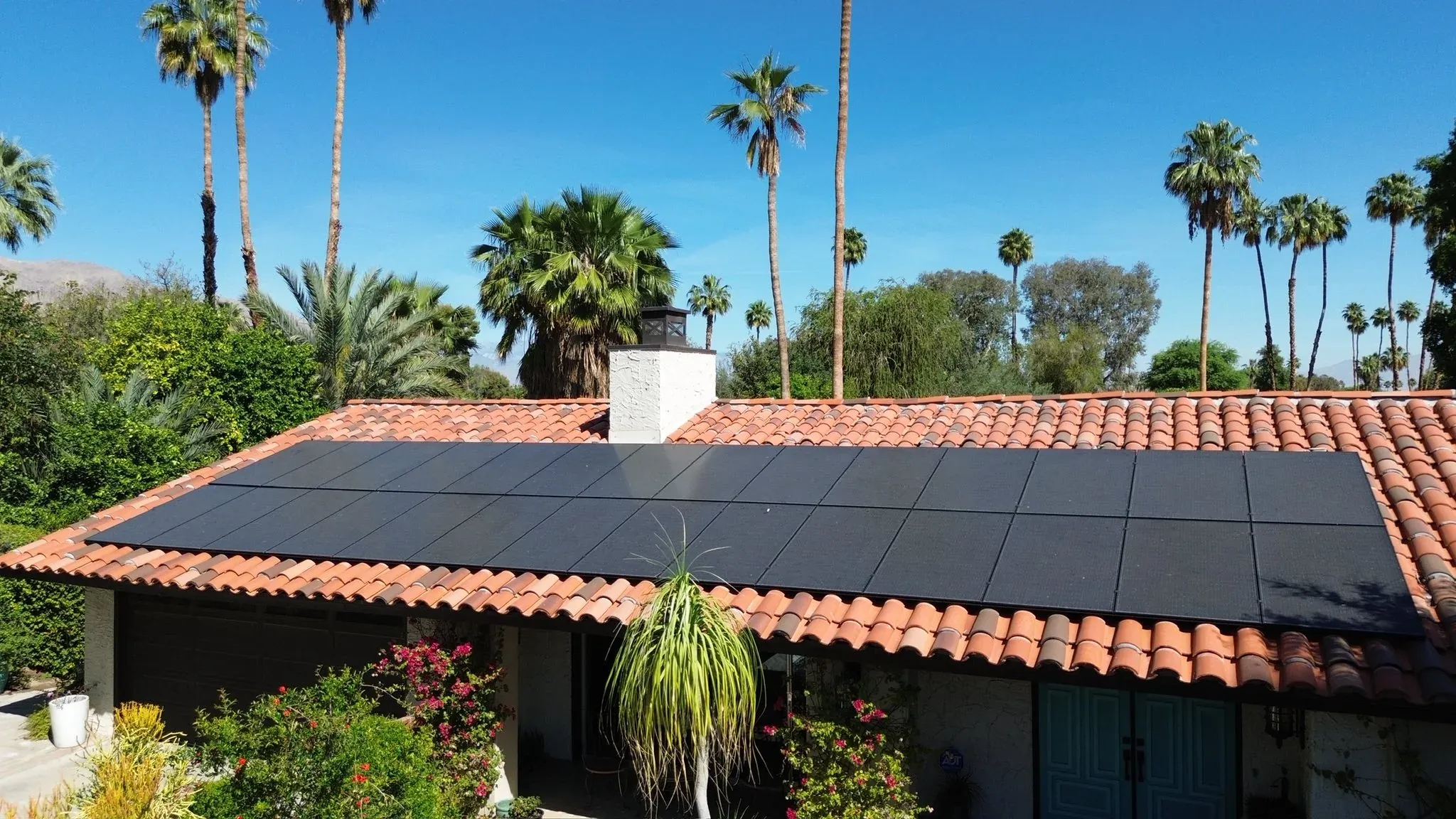
The manufacturer’s standard recommendation of cleaning solar panels once or twice a year does not apply to the Coachella Valley. Desert conditions create much higher soiling rates than national averages, and the inverter data backs that up.
Recommended cleaning cadence
For residential properties:
- Standard cadence: every 4 months (3× yearly)
- Higher-soiling cadence: consider every 3 months if you’re in the west valley, near San Gorgonio Pass, or downwind of construction or agriculture
- Manufacturer guidance: check the cleaning and maintenance instructions for the installed module model
For commercial properties:
- Quarterly cleaning is typical
- High-soiling sites may require bimonthly service
Why twice-yearly cleaning falls short
The Coachella Valley receives only 3-4 inches of annual rainfall, nowhere near enough for rain to clean panels naturally. The factors stacking up against your array:
- Westerly winds through San Gorgonio Pass carry silica dust year-round
- Monsoon season (July-September) produces significant dust storms
- Agricultural sources in the east valley add organic particulates
- Wet-dry cycles deposit mineral residue on panel surfaces
In these conditions, a panel can lose 8-15% of its output within two to three weeks of a clean.
What the production data shows
Monitoring systems reveal two common patterns:
- A gradual 10-20% production decline from accumulated soiling, with professional cleaning typically recovering 12-18% same-day
- Erratic output following dust events and light rain (which lifts dust and re-deposits it as spotting)
Cleaning frequency by location
| Cadence | Areas |
|---|---|
| Every 3 months | Palm Springs, Cathedral City, Desert Hot Springs, anywhere within half a mile of active construction |
| Every 4 months | Rancho Mirage, Palm Desert, Indian Wells, most of La Quinta |
| Every 5-6 months | Properties sheltered by hills, mature landscaping, or structural wind barriers |
Trigger events that call for an unscheduled clean
- Visible monsoon dust accumulation
- Prolonged construction-related grit exposure
- Wildfire ash (it bonds more aggressively than ordinary dust)
- A sudden monitored production drop that isn’t resolved within one week
Commercial considerations
For commercial arrays, optimal cadence depends on kWh recovery modeling against your utility rates and service costs. For most commercial installations, quarterly service generally outperforms a semi-annual schedule financially, the production you recover between visits more than covers the extra cleans.