
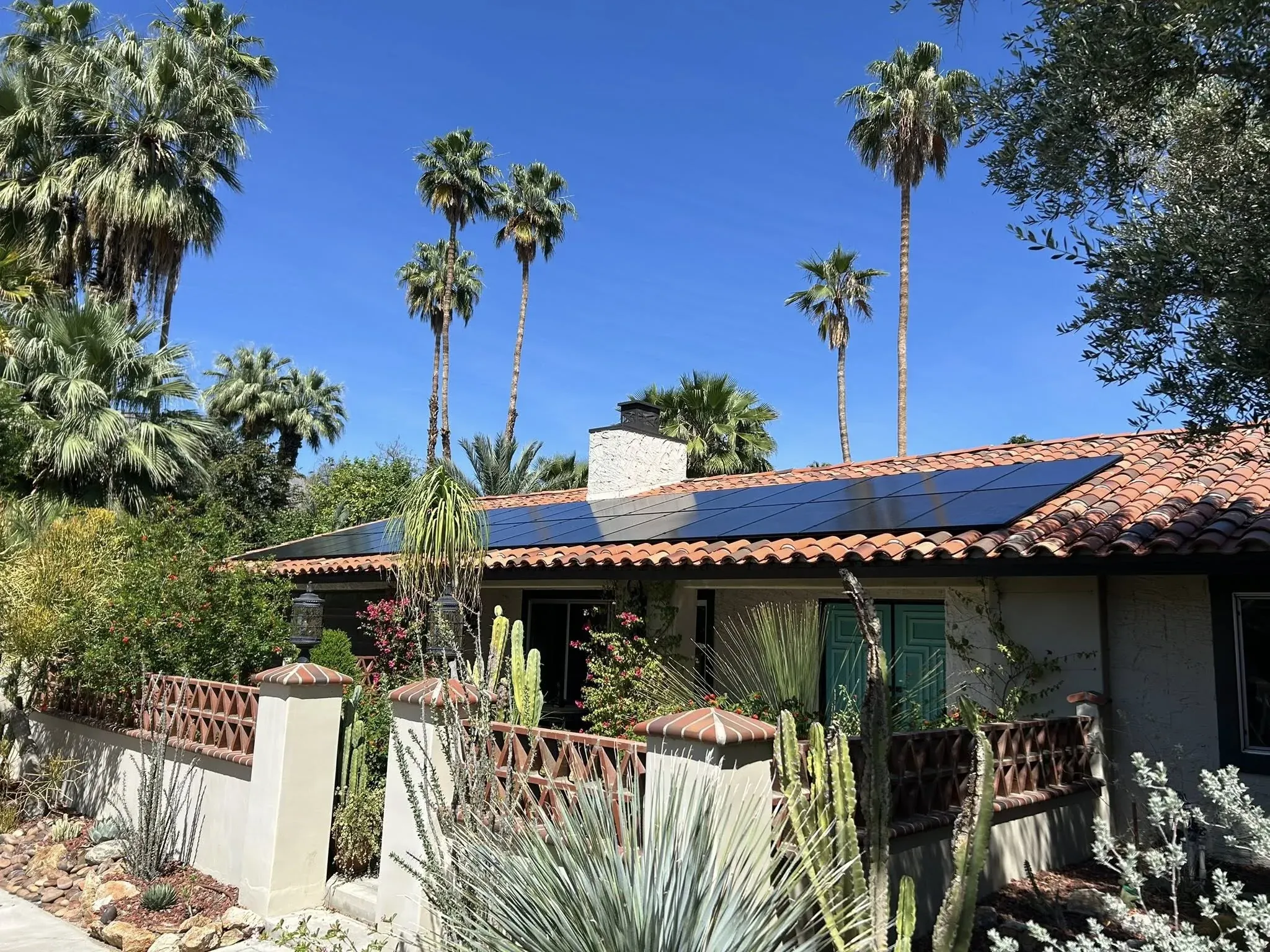
The honest answer: it depends mostly on how many panels you have and what kind of site they sit on, whether that’s a home roof, a commercial building, or a ground-mount field.
Both variables affect pricing in predictable ways, so you can compare a quote with the likely value of the service before you book. Here is how we price drone solar cleaning in 2026 and how to estimate the potential production benefit without assuming a guaranteed return.
Residential: starts at $150
For a Coachella Valley home, we charge $9.00 per panel with a $150 minimum, which covers arrays up to about 16 panels.
So:
- 10-panel system → $150 (minimum)
- 24-panel system → 24 × $9.00 = $216
- 40-panel system → 40 × $9.00 = $360
- 60-panel system → 60 × $9.00 = $540
That price includes the pre-flight walk, a deionized water pass, before/after photo documentation, and a soft-edge perimeter pass that keeps your tile lines clean. No ladder marks, no foot traffic, no broken tile.
We do not automatically raise the residential price because the home is two stories or has Spanish tile, since the cleaning crew operates from the ground. The final quote can still account for the array layout, safe flight area, property access, and other job-specific conditions.
Commercial: quoted by site
For warehouse, retail, office, and hospitality arrays, usually 250 to 25,000 panels, we quote per site rather than per panel, because the price is driven by more than the panel count:
- Access windows. A grocery store roof we can fly at 5 a.m. before opening is a different job than a 24/7 distribution center where we coordinate around live operations.
- Cadence. Quarterly service contracts price differently than a one-time clean. You’re trading some flexibility for a per-visit discount and a kWh recovery report.
- Add-ons. Thermal scans, soiling reports, COI requirements, and bird-fouling treatment all stack on top of the base clean.
- Volume. At 500+ panels, our per-panel rate drops into volume territory.
Commercial cleans start from a $200 base plus $4.00 per panel, then adjust for the factors above. A 300-panel retail roof lands around $1,400 for a one-time clean, with quarterly contracts pricing lower per visit. We’ll always give you a fixed number after a site walk. No surprise surcharges.
Utility-scale: contracted per MW
Ground-mount fields and tracker arrays in the 25,000 to 250,000+ panel range price by megawatt block, not per panel. At this scale the dollar-per-panel number stops mattering; throughput and production scheduling drive the cost.
A drone fleet runs roughly 2.6× faster than a crew-based wash on a comparable site, which is most of why utility cleaning pencils at all. We sequence rows around the production schedule and hand back a per-row soiling and recovery dataset in your format (CSV, SCADA-ready, whatever your O&M team wants).
If you’re modeling this for a project, talk to us. We’ll quote against your site map and production curve.
The math: does it actually pay for itself?
For most Coachella Valley systems, yes, but the why is worth understanding.
A dusty panel produces less power. The exact loss depends on the dust load, the angle of the array, and the time of year, but in the desert it’s normally somewhere in the 8-25% range between cleans. The number comes straight from inverter data: compare a pre-clean week to a post-clean week on the same site.
The payback math takes three steps:
- Your system’s annual production (from your monitoring app) × your soiling loss % = kWh lost to dust each year.
- That × your blended electricity rate = dollars lost each year.
- Compare that to clean cost × cleans per year.
Run it for a typical 20-panel valley home producing ~10,000 kWh/year:
- 10,000 kWh × 15% soiling loss = 1,500 kWh lost each year
- 1,500 kWh × $0.40/kWh = roughly $600/year in lost production
- Two cleans a year at $180 each (20 panels × $9.00) = $360
Net to you: $240/year, plus a longer panel lifespan because you’re not baking dust onto the glass. How many cleans a year makes sense for your site is its own question, covered in our cleaning cadence guide.
For commercial, the same math scales up fast: a 1,500-panel warehouse roof losing 12% to soiling can be leaving five figures a year on the table.
What you should be skeptical of
A few things to push back on if you see them in a quote:
- “Free” cleanings bundled with something else. The price didn’t disappear. It moved somewhere you can’t see it.
- Per-visit prices that swing with roof type. For drone work, roof material shouldn’t change the number. Nobody’s on your roof.
- A rinse that stops at tap water. Whatever gets used to lift the soiling, the final rinse should be deionized. Ordinary hard water dries into the mineral spotting that module care instructions specifically warn about. Ask what the cleaning product is rated for and how the panels get rinsed.
- Vague “soiling reports” with no methodology. Ask how the number was measured. If it’s not based on pre/post production data or a reference cell, it’s a guess.
Want a real number for your system?
The fastest way to get a real quote is to send us your address and a photo or system size. For residential, we can usually give you a confirmed price within an hour. For commercial, we’ll schedule a 15-minute site walk and get you a fixed proposal within two business days.