
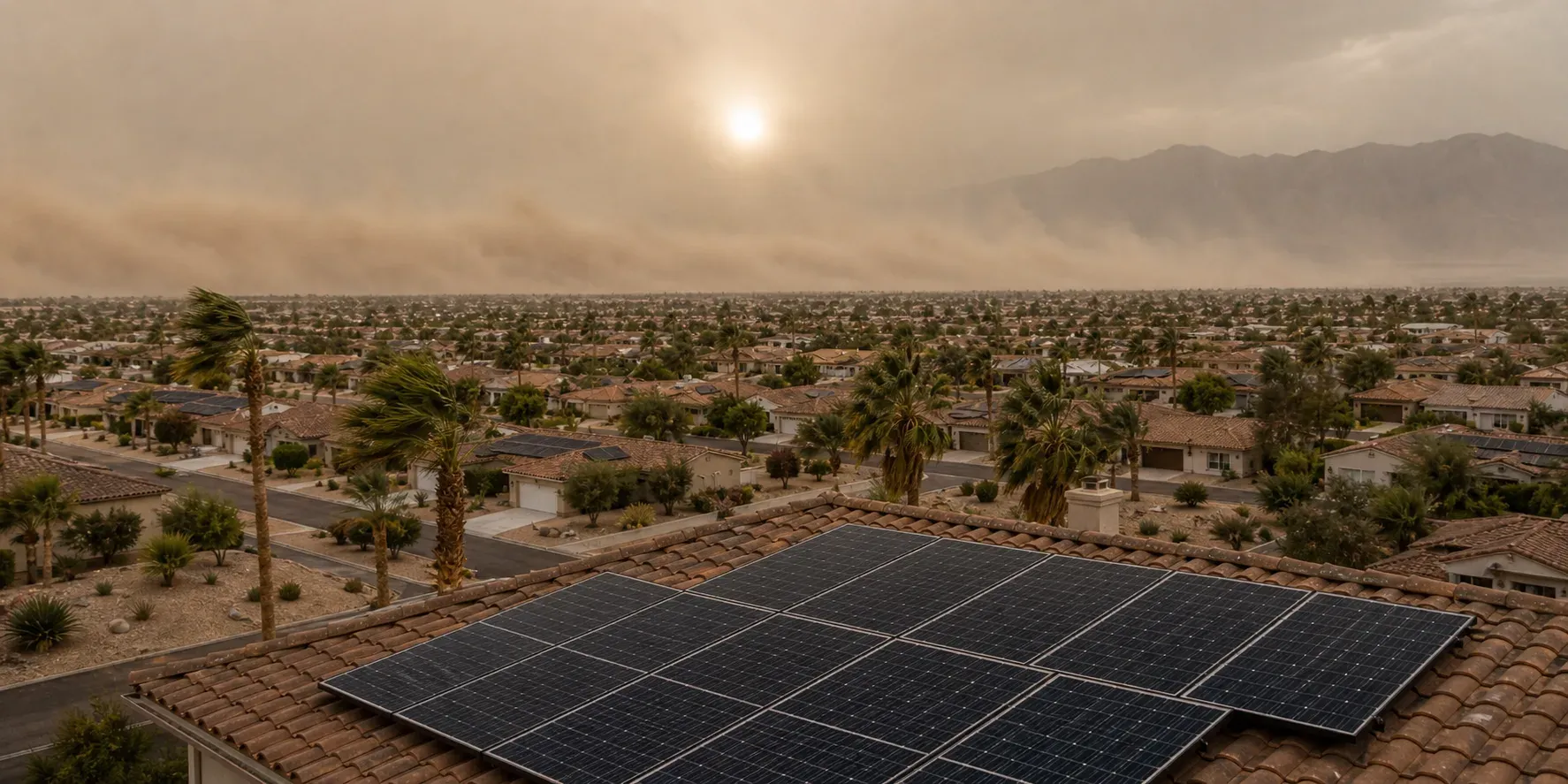
Monsoon season officially runs June 15 through September 30, and in the Coachella Valley that means one thing for solar owners: dust storms. Outflow winds, blowing sand, and the occasional wall of dust rolling across the valley floor, followed by just enough rain to turn everything on your panels into mud.
So the question we get every July: should I clean my panels before the storm hits, or wait until after?
The answer is after, and the honest version of why will also save you money.
What a monsoon storm actually puts on your panels
A summer dust event is a different kind of soiling than everyday desert dust:
- Volume, all at once. The westerly winds through San Gorgonio Pass coat panels gradually over weeks. A storm’s outflow winds can deposit that much silica, sand, and agricultural particulate in a single afternoon.
- Dirty rain. Monsoon moisture often arrives as light rain falling through dust-loaded air. Each drop carries dust down with it, then evaporates in minutes on hot glass, leaving mud spots and mineral rings instead of a rinse.
- The bake-on cycle. July panel glass runs far hotter than the air. Wet dust dries fast, and repeated wet-dry cycles cement mineral residue onto the surface. What starts as loose dust becomes a film that light rain will never remove.
That last part is why timing matters. Loose dust after a storm is easy to lift with a deionized water pass. The same dust after two weeks of heat, humidity, and another sprinkle or two has started bonding to the glass.
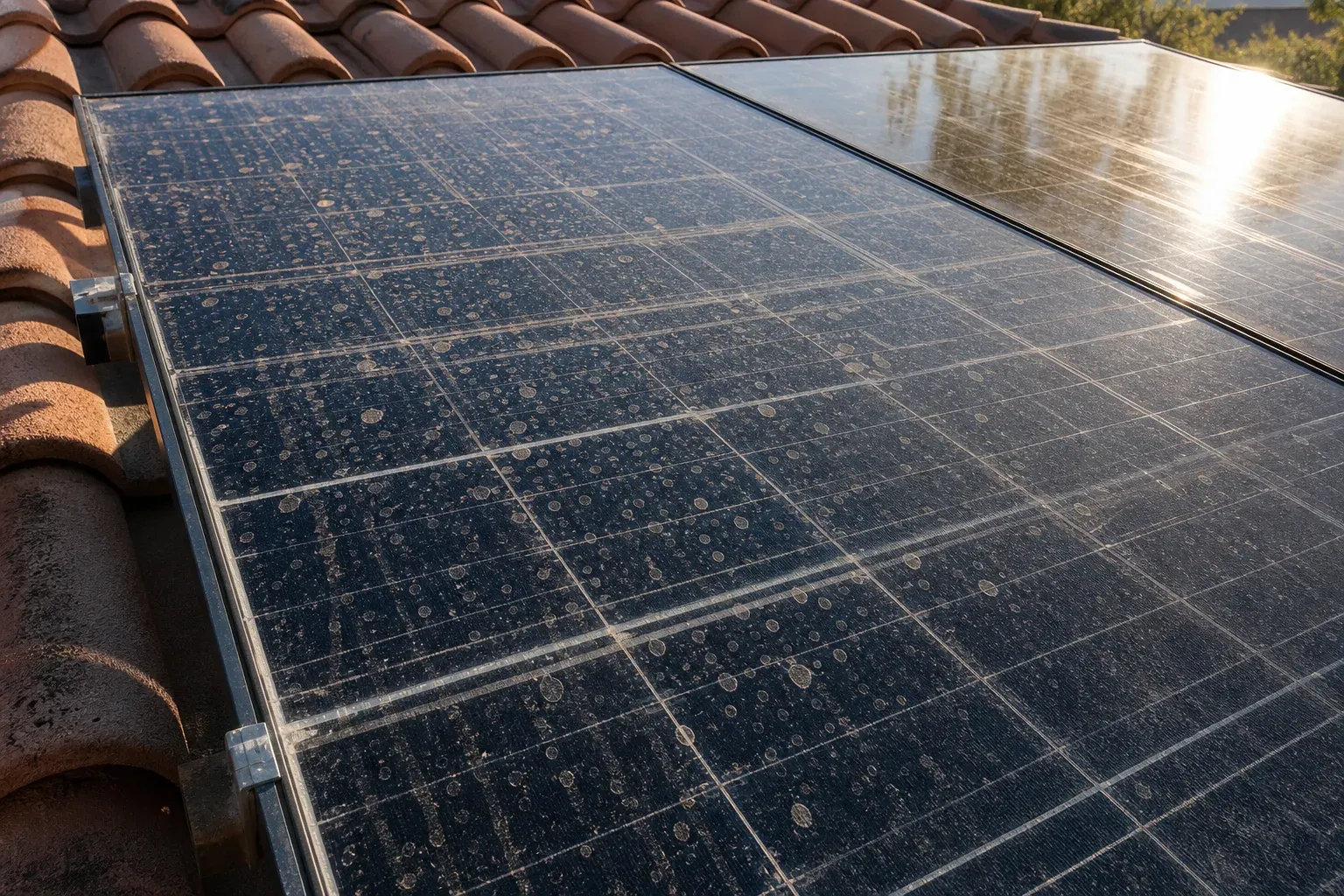
This is what “dirty rain” leaves behind: drops that carried dust down onto the glass, then evaporated into rings. Light rain doesn’t clean panels here, it stamps the dust on.
”But doesn’t rain clean the panels?”
This is the most common reason people wait, and it’s worth being precise about, because there’s a well-known study behind the advice, and it doesn’t say what most people think it says.
Researchers at UC San Diego analyzed 186 solar systems across California and found that during a 145-day dry stretch, typical panels lost only about 7.4% of their output, roughly 0.05% per day. Their conclusion: for the average California home, rain does enough of the job that paying for cleaning often isn’t worth it. That finding is where the generic “don’t bother cleaning your panels” advice you see online comes from.
The advice usually leaves out the second half. The same researchers named the exceptions where cleaning does pay: panels near agriculture, highways, or other heavy dust sources, panels mounted at low tilt where dirt doesn’t slide off, and, in their words, exceptional events like desert dust storms.
Those exceptions matter in the Coachella Valley: agriculture in the east valley, monsoon dust events, year-round silica through the pass, and only 3 to 4 inches of annual rainfall. The statewide study is useful context, but it does not establish the right cleaning schedule for every desert property. Local monitoring and visible soiling should guide the decision.
So no, rain will not save your panels here. Most summers, it actively works against them.
Why cleaning before a storm is the wrong call
If a dust storm is in the forecast and your panels are due for a clean, wait. A cleaning the day before a storm buys you one day of full production, then the storm resets the glass to dirty, and you’re back where you started minus the cost of the clean.
Any cleaner who takes your money the afternoon before a forecast haboob is optimizing for their schedule, not your production. We’d rather tell you to wait, and it’s the same reason we’ll tell you a cleaning won’t lower your bill if your panels are already clean: the service only makes sense when there’s production to recover.
The after-storm window
Once the storm passes, use a simple check before deciding whether to schedule service:
- Look at your monitoring app, not your roof. From the driveway, storm soiling can read as light haze. Your inverter data doesn’t lie: compare the days after the storm to the week before.
- Give one good look for mud spotting. If dirty rain fell, you’ll see the drip rings and streaks near the lower edge of the panels. That spotting is the residue that bakes on fastest.
- Schedule if the decline persists and the panels show buildup. Dust may be the cause, but equipment issues and weather can also reduce production; contact the installer or a qualified technician if the data suggests a system problem.
A storm event is exactly the kind of trigger that sits outside your normal cleaning cadence. If you’re on a recurring schedule with us and a storm hits mid-cycle, that’s what an extra visit is for, and at $9 per panel with a $150 minimum, an unplanned clean on a 24-panel home is a $216 decision against weeks of lost summer production, in the exact months your panels should be earning the most.
Skip the garden hose
After a storm, the temptation is to get up there with a hose. Three reasons we’d rather you didn’t:
- Tap water is the wrong water. Desert tap water is hard, and it dries into exactly the mineral spotting you’re trying to remove. Module warranties call for deionized water for a reason, and DI is all we ever put on glass.
- The manufacturers themselves say don’t. Qcells, the largest panel manufacturer in the US, tells owners that panels need periodic cleaning and warns about falling and burn risks of doing it yourself. Summer roof surfaces and panel frames get hot enough to make that warning literal.
- Your roof wasn’t built for the trip. If you’re on tile, one wrong step is a cracked tile and a slow leak. Our drone cleans the entire array without anyone, including you, setting foot up there.
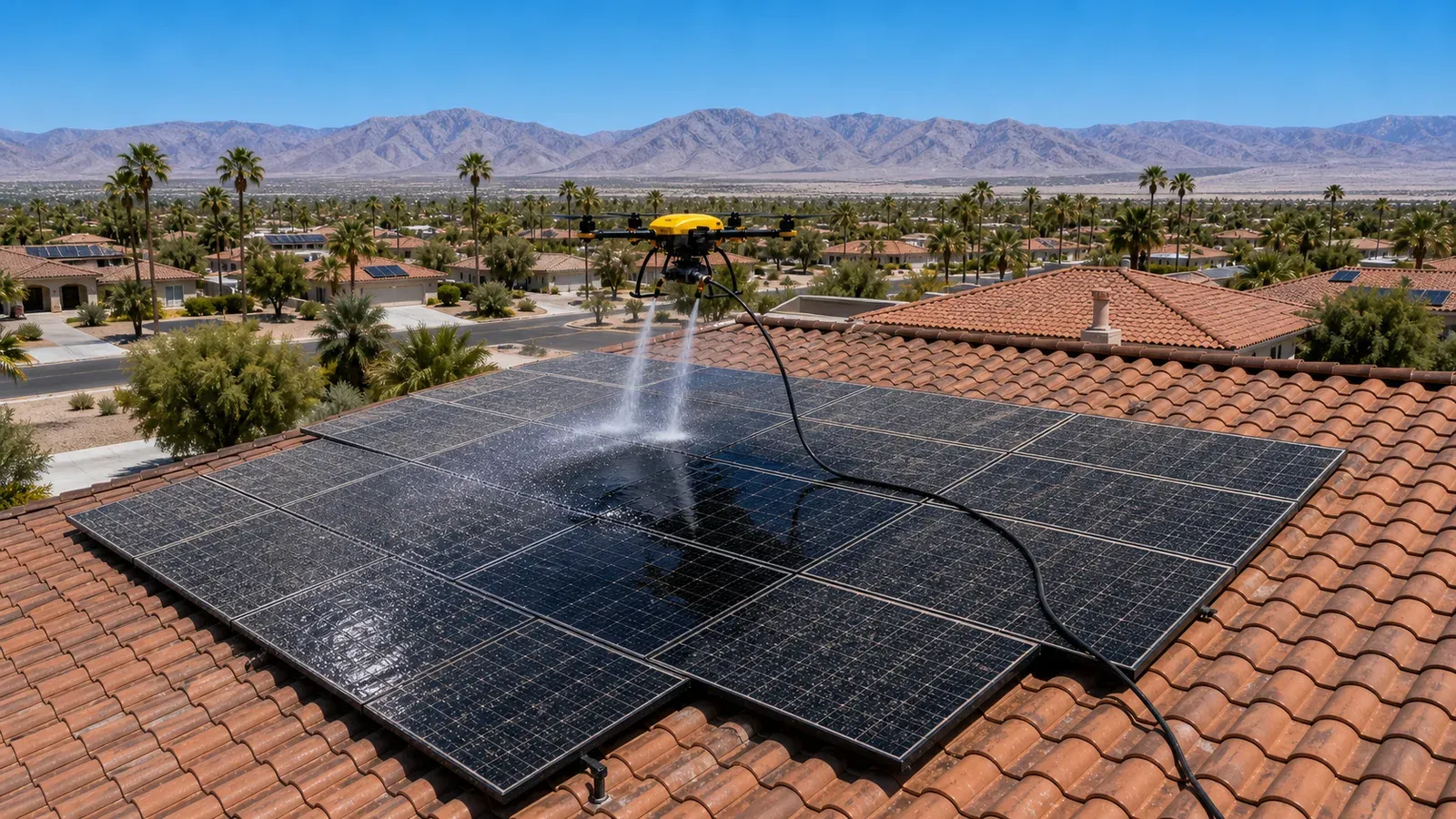
The after-storm clean: deionized water from above, no ladders, no one on the tile, and the dust is off before the heat can bake it on.
The short version
If a dust storm is forecast, it usually makes sense to wait until it has passed. Afterward, review production, look for visible buildup from the ground, and schedule cleaning if the residue remains. If production stays low after the panels are clean, ask the installer or a qualified technician to check the system.
If a monsoon storm just rolled through your neighborhood, send us your address and panel count and we’ll tell you straight whether your array needs a visit or whether it can wait for your regular clean, no charge either way.