
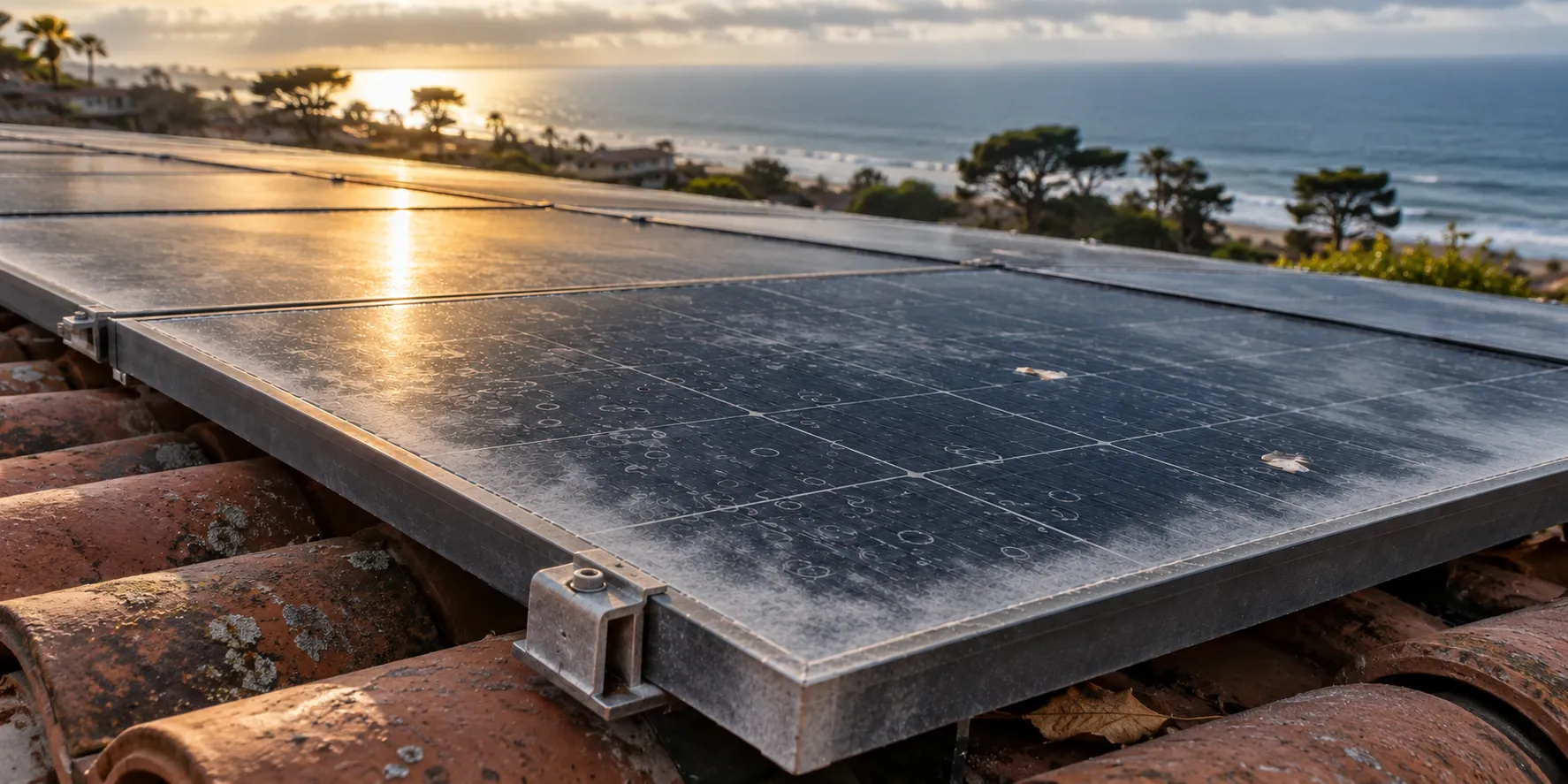
If you own solar within sight of the water in Oceanside, Carlsbad, Encinitas, Del Mar, or La Jolla, someone has probably told you that salt air is eating your panels. It’s the standard pitch on the coast, and it usually arrives with an urgent recommendation to book something.
The honest answer is that salt air does damage solar systems, it damages them in a specific way that’s worth understanding, and almost every version of the story you’ll hear gets the mechanism wrong.
What salt actually does to a solar array
Sea spray puts microscopic salt particles into the air, the sea breeze carries them inland, and they settle on every surface they reach, including your panels. On their own, dry, they’re just soiling.
The problem starts when the marine layer rolls in. Salt is hygroscopic, so it pulls moisture out of humid air, and the moment it dissolves it stops being dust and becomes a chloride electrolyte sitting on your array. That’s a corrosive solution, and it goes to work on four things at once:
- The frame. Aluminum frames corrode from the edges and fasteners inward, which matters structurally on a coastal roof that also takes wind.
- The junction box and connectors. Corroded contacts raise electrical resistance, which costs output and, at the extreme, becomes a safety issue.
- The cell metallization. This is the one that matters most. If salt ions reach past the encapsulant, they corrode the fine metal grid printed on the cells that carries the current out. That damage is irreversible. No cleaning brings it back.
- The seals. Every corrosion pathway above depends on moisture getting where it shouldn’t, and salt accelerates that too.
You can see the aggregate effect in field data. NREL’s compendium of degradation rates, which pooled more than 11,000 measured degradation rates across roughly 200 studies, puts the median for crystalline silicon at 0.5 to 0.6% per year. Coastal and humid installations run closer to 0.7 to 1.0%. Over a 25-year system that gap is real money, and it is the actual cost of living near the ocean.
For arrays genuinely exposed to marine conditions, there’s even a dedicated standard: IEC 61701 subjects modules to 5% salt fog cycled with humidity storage for 56 days, in severity levels up to 6. The fact that the industry built a corrosion torture test specifically for salt tells you the concern is not marketing.
The claim we’re not going to make
Here’s where we part ways with a lot of coastal cleaning copy.
You’ll read that salt “etches the glass,” that the haze becomes permanent, that the damage is burned in and can’t be removed. That’s not what’s happening on your roof, and it’s worth being precise about why.
Salt is not an etchant. Glass is attacked by hydrofluoric acid and by strong alkali, not by sodium chloride. What salt does do, over long exposure, is set up the conditions for slow surface alteration: salt deposits pull moisture out of humid air, that film leaches sodium out of the glass surface, and if it sits long enough the film turns alkaline enough to begin working on the glass itself. Researchers studying marine aerosols on silicate glass have documented exactly that sequence.
But that is a years-and-decades process on architectural glass, and your panels are toughened low-iron glass that gets rinsed by rain and by us. It is not what’s costing you output this year, and it is not something a cleaning could reverse if it were. Anyone pointing at your array and telling you the salt is eating the glass right now is describing a problem that cleaning would not solve.
If a cleaner tells you the salt is etching your glass, they’re either repeating something they read or hoping you won’t check.
What’s actually true is less dramatic and more useful.
Cementation: why waiting is what costs you
Salt doesn’t damage the glass. It welds other things to it.
Salt, dust, and moisture together produce a gluing effect. Each marine-layer morning wets the deposit, each sunny afternoon dries it, and every one of those cycles binds the mix a little harder to the surface. Researchers studying soiling and cementation found that cemented deposits become substantially harder to remove, and that organic material landing on top makes it worse still.
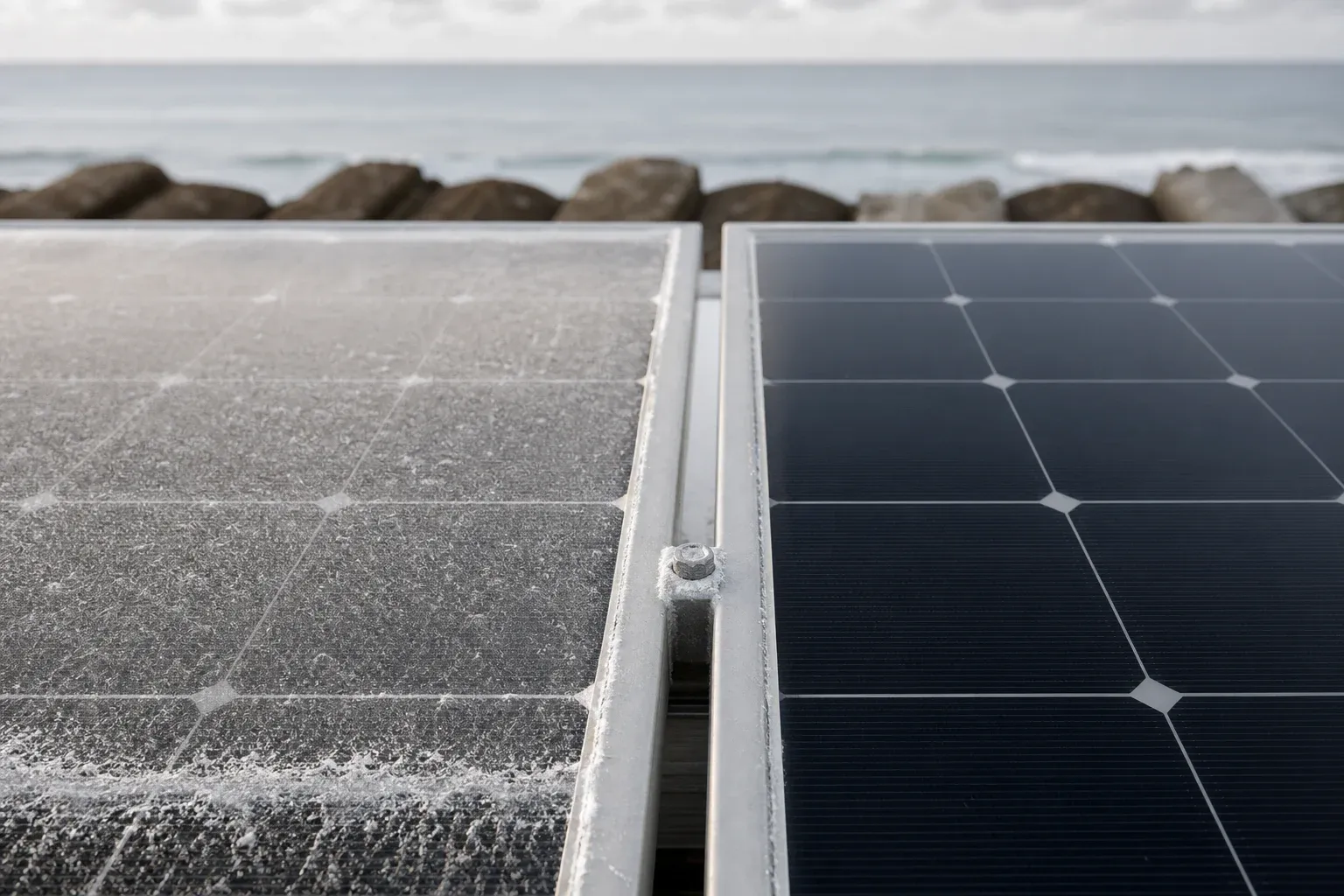
Left panel, right panel, same array. The white bloom on the frame and the fastener between them is the corrosion doing the damage that cleaning can’t undo.
That’s the real coastal timeline. In month three, the film on your panels is loose and lifts with a rinse. By month eight, it’s bonded, and getting it off takes contact and effort, which is exactly what your panel’s warranty documentation tells people not to apply.
So the argument for cleaning coastal solar on a schedule isn’t that the glass will be ruined if you don’t. It’s that soiling here converts from easy to difficult on a clock, and the corrosion underneath is running the whole time.
One thing we won’t do is inflate the production numbers. Coastal soiling losses are genuinely smaller than desert ones. Our Coachella Valley arrays commonly run 10 to 20% below potential between cleanings; coastal marine studies put salt-deposition losses at a few percent a year. If someone quotes you desert recovery figures for a Carlsbad roof, they’re using the wrong region’s math. The coastal case rests on corrosion and cementation, not on a dramatic same-day production jump.
Your address matters more than you’d think
Salt aerosol drops off fast as it moves inland, and not in a straight line. Coastal transect studies show a steep decline across the first two miles or so, then a much flatter curve after that, with total salt deposition falling by a factor of twenty to thirty by the time you’re six miles from the water.
That’s why North County splits so cleanly, and why our city pages don’t give everyone the same answer:
- Bluff and beachfront (Del Mar’s Beach Colony, La Jolla oceanfront, the Leucadia and Cardiff bluffs) sit in near-constant mist. Three months.
- Within a mile or two of the water (South Oceanside, the Carlsbad Village, coastal Encinitas, Solana Beach) get steady aerosol but not direct spray. Three to four months.
- Inland North County (La Costa, Aviara, Bressi Ranch, Rancho del Oro, Ocean Hills, San Marcos, Escondido) is past the steep part of the curve. Four months, and the soiling you’re fighting is more dust and pollen than salt.
If a company quotes the same interval for a Del Mar bluff house and a home in Escondido, they haven’t looked at where you live. You can check your own city on our San Diego County service area pages.
The gulls
North County has a soiling source the desert doesn’t, and it does damage out of proportion to its size.
A bird dropping doesn’t just shade a bit of glass. It blocks its cell completely, and a blocked cell in a working panel stops producing and starts absorbing: the current the other cells are still generating flows through it and turns into heat. That’s a hot spot. It wastes output while it’s there, it ages that part of the module faster, and through a rainless summer it bakes the residue into something far harder to lift than what landed.
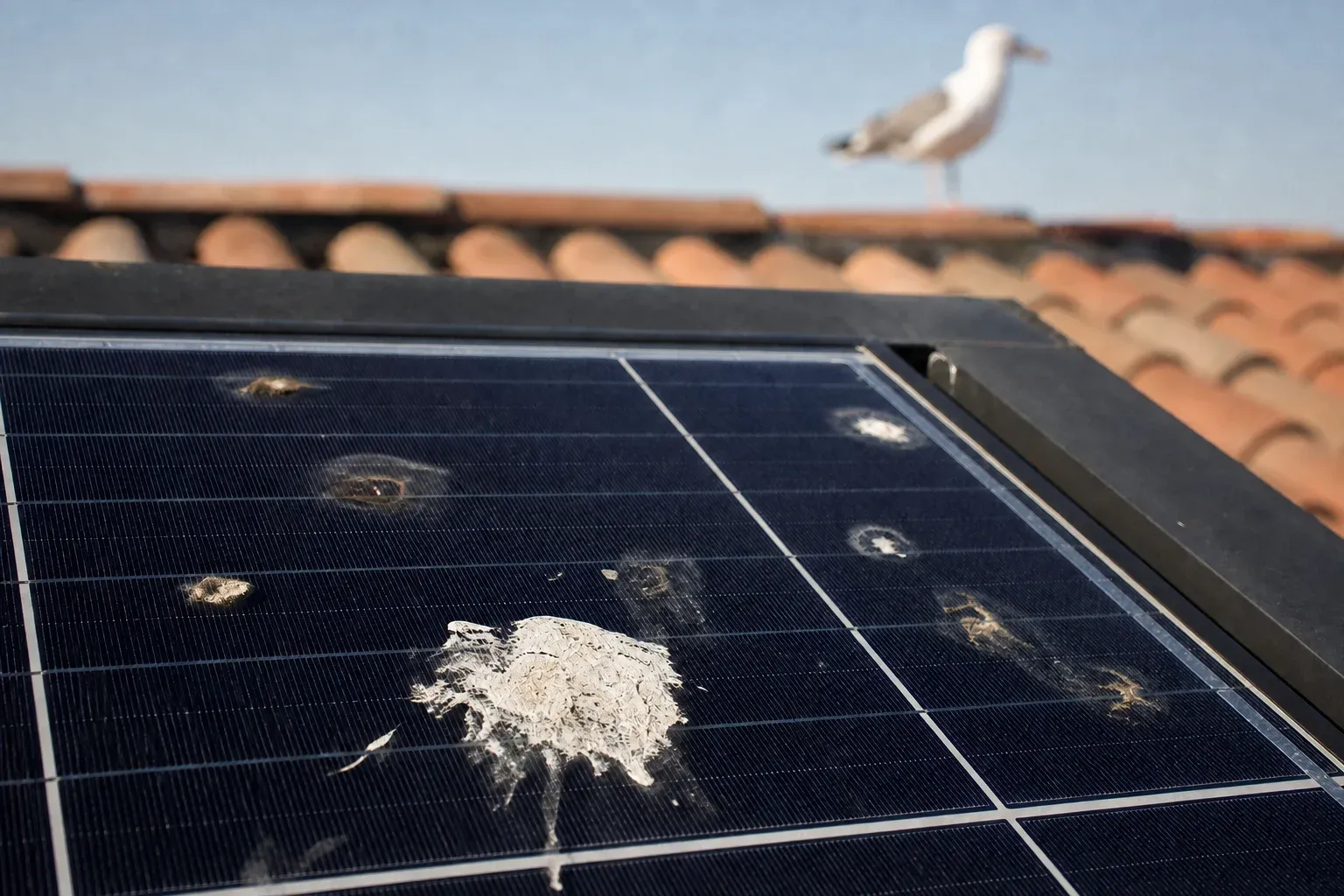
Every one of those spots is a cell that stopped producing and started heating. The large one has been there long enough to bond to the glass.
The unpleasant detail is that bypass diodes, the protection built into your panels for exactly this problem, often don’t engage for a spot this small, because the module’s voltage doesn’t drop enough to trigger them. So the hot spot runs unprotected until someone cleans it off.
Which is a long way of saying: on the coast, droppings are worth dealing with promptly, and they’re a poor reason to climb on a roof yourself.
What’s actually safe to put on coastal panels
This is where most coastal solar owners get bad advice, so it’s worth quoting the manufacturers directly rather than telling you what we think.
REC’s cleaning guide, for panels found on plenty of North County roofs, is unusually blunt:
“The use of pressure or steam cleaners and high pressure hoses for cleaning is not permitted as these may exert pressure in excess of the certified load and cause impact damage, damage to the frame bonding, the laminate or cells and force water between the glass and frame.”
And it adds that doing so will invalidate the warranty. The same document says never to stand, walk, lean on, or apply pressure to panels at any point, because a person’s weight concentrated through a shoe far exceeds the load the panel was certified for.
On what you can use, the guidance is more permissive than the internet thinks:
“Ideally, de-ionized water should be used to clean the panel.”
“If marks still remain on the panels, a mild biological and biodegradable washing-up liquid may be used on the panels. The panel must be immediately rinsed with plenty of water.”
Acid and alkali detergents are prohibited. First Solar’s guidelines agree, permitting a mild, non-abrasive, non-caustic detergent between pH 6.5 and 8.5, requiring deionized or low-mineral water, and, for panels with anti-reflective coated glass, prohibiting wet contact cleaning entirely: no squeegees, sponges, or cloths combined with water.
That last restriction deserves a moment. The anti-reflective coating on modern module glass is porous silica around 100 nanometers thick, roughly one five-hundredth the width of a human hair. It’s what squeezes the last few percent of light into your cells, and it abrades off under brushes and pressure. Once it’s gone, it’s gone.
Put the manufacturer guidance in a list and you get a description of how we work:
- Deionized water, so nothing dries onto the glass as mineral spotting
- A mild cleaning solution formulated for photovoltaic glass when the soiling needs lifting, then rinsed off
- No pressure washing
- Nothing in contact with the panel surface at all
- Nobody standing on the array, or on the roof
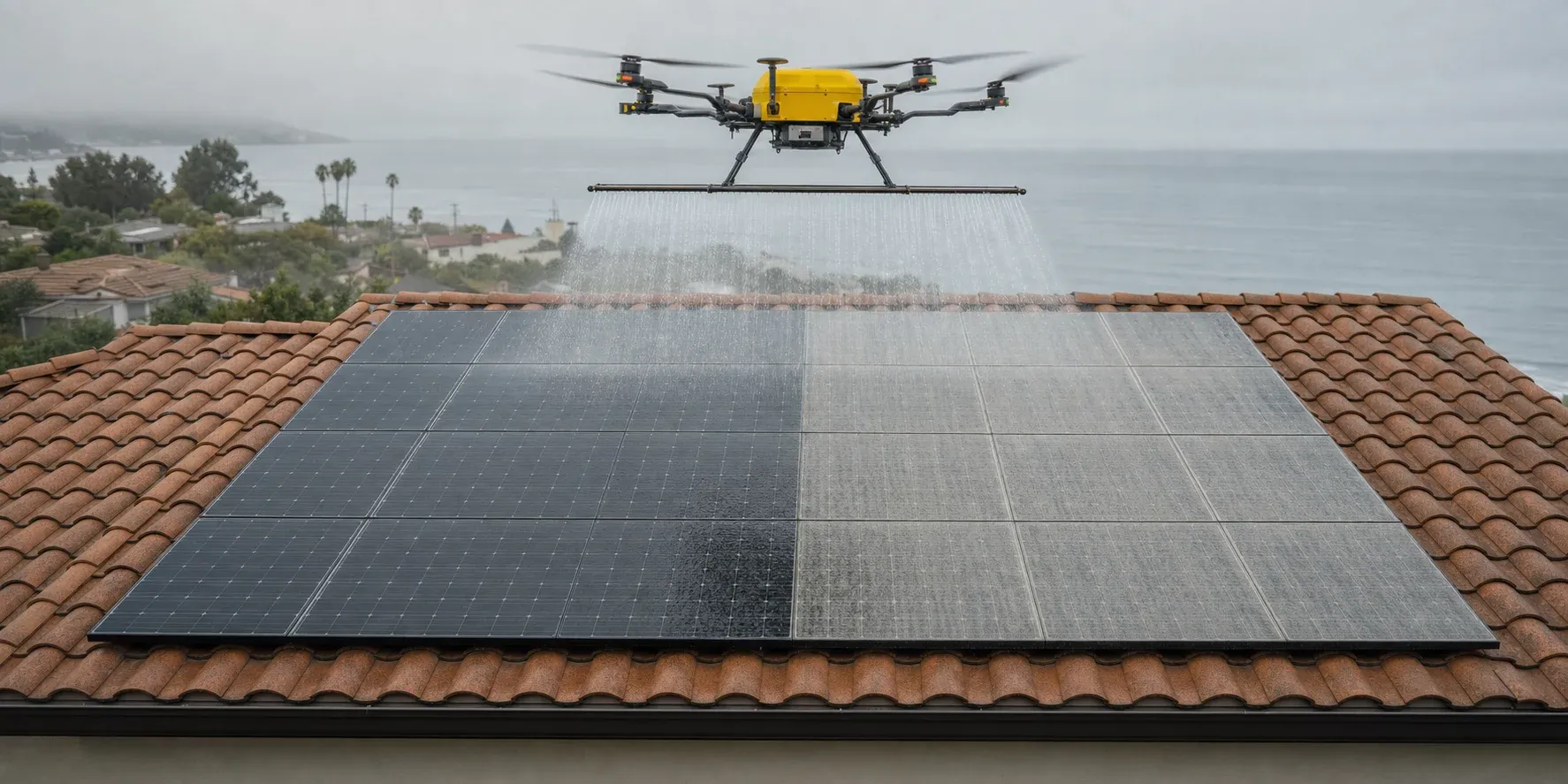
A wide, low-pressure rinse rather than a jet, and nothing but water in contact with the glass. The line down the middle is where we’ve reached.
And you also get a description of what a cleaner with a pressure washer, a brush on a pole, and a garden hose is doing to your warranty.
The tile roof problem, again
Coastal North County has a second complication stacked on the first. La Costa, Aviara, Ocean Hills, Olde Del Mar, and most of La Jolla’s Spanish revivals are tile, and tile was never engineered to be walked on. Coastal mornings make it worse: marine-layer moisture keeps tile slick well past sunrise, which is exactly when a cleaning crew wants to be working before the glass heats up.
We covered that in detail in is drone solar cleaning safe for tile roofs, but the short version is that the manufacturer guidance and the roof are telling you the same thing from two directions. Nothing should be on your panels, and nobody should be on your tile.
The short version
Salt air does damage solar panels. It corrodes the metal parts, some of that damage doesn’t come back, and coastal systems measurably age faster than inland ones. What it does not do is etch your glass, and anyone who tells you otherwise is selling from a script.
What you can control is the film. Kept on a schedule that matches your distance from the water, coastal soiling stays a film that rinses off. Left alone, it cements, and the corrosion underneath it keeps running either way.
If you’re in North County and want a straight answer about your own array, send us your address and panel count. We’ll tell you what interval your location actually calls for, and if your panels don’t need us yet, we’ll say that instead. Residential cleaning runs $9 per panel with a $150 minimum, and the full breakdown is in our cost guide.