
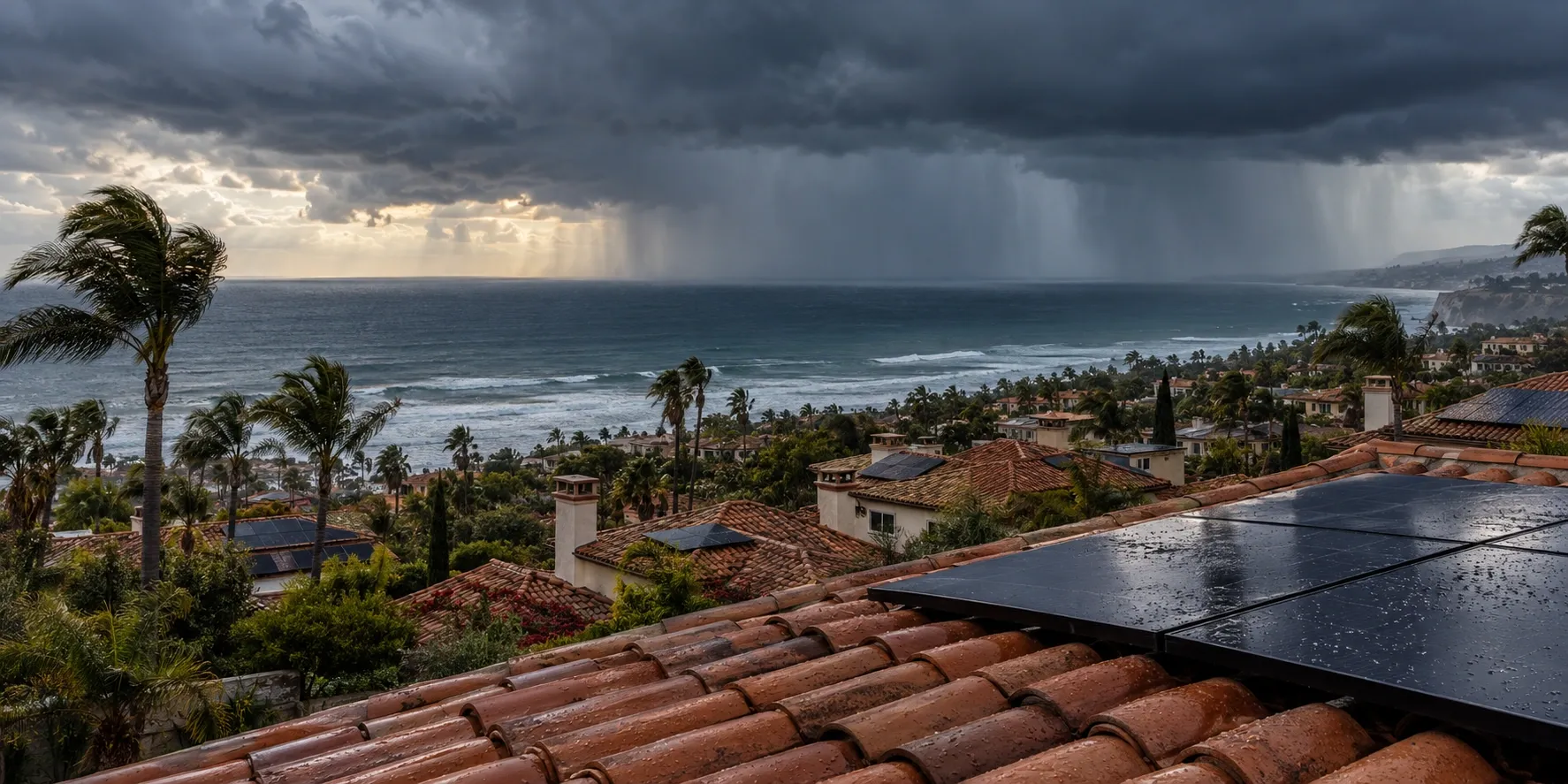
NOAA’s latest word on this winter is about as loud as seasonal forecasting gets. The Climate Prediction Center puts the odds of a very strong El Niño above 90%, and gives a 75% chance that this fall will beat every El Niño on record since 1950.
If you own solar in Southern California, the natural question is whether a record wet winter means you can skip cleaning until spring. We clean panels by drone in two places that answer that question in opposite ways. In San Diego’s North County, a genuinely wet El Niño will do part of the job for you. In the Coachella Valley, it won’t come close. In both, the rain leaves work behind.
We pulled forty-plus years of NOAA station records for both regions to show exactly how that plays out.
What NOAA is actually forecasting
Two NOAA products matter here, and they say different things.
The first is the ENSO diagnostic discussion issued September 10, 2026. It’s about the ocean. Sea surface temperatures in the key Niño-3.4 region ran 1.8°C above normal in August, and NOAA’s synopsis is blunt: “El Niño is strengthening, with a greater than 90% chance of a very strong event during the Northern Hemisphere fall and winter 2026-27.”
The second is the seasonal outlook issued September 17. It’s about the weather that El Niño tends to bring. For California, the odds of a wetter-than-normal season build through the winter and peak at 50 to 60 percent near the coast from December through April.
Read those two numbers side by side. A 90% chance of a very strong El Niño becomes, at best, a 60% lean toward a wet winter on the coast. NOAA says it plainly in the same discussion: with an event this size, the chances of typical El Niño impacts “are larger, but they are not guaranteed.”
A strong El Niño doesn’t guarantee a wet winter
The three strongest El Niños in NOAA’s record since 1950 are 1982–83, 1997–98, and 2015–16. The most recent strong one, 2023–24, was close behind. Here’s what each did to October-through-March rainfall at four stations in our two service areas:
| Station (Oct–Mar rain) | Average | 1982–83 | 1997–98 | 2015–16 | 2023–24 |
|---|---|---|---|---|---|
| San Diego Airport | 8.36 in | 16.13 in | 15.08 in | 6.87 in | 12.18 in |
| Oceanside Marina | 9.41 in | 14.44 in | 15.00 in | 4.23 in | 15.73 in |
| Palm Springs | 3.97 in | 7.06 in | incomplete | 3.35 in | 3.29 in |
| Thermal | 2.26 in | 4.95 in | 2.42 in | 1.63 in | 2.24 in |
Source: NOAA station data via the Regional Climate Centers’ ACIS service, Oct 1 through Mar 31 of each winter. “Average” is the mean of complete October–March seasons from 1991–2020 at each station, calculated by us. It is not NOAA’s official 30-year normal.
Two El Niños delivered the soaking everyone pictures. The strongest of the three, 2015–16, left Oceanside at 45% of its average winter rain and San Diego’s airport at 82%. Researchers at Scripps Institution of Oceanography later traced the miss to warm water in the western Pacific and Indian Ocean, which pushed storms north that would otherwise have hit California. The Pacific Northwest got the rain instead. That study was published by Nick Siler and colleagues in the Journal of Climate in 2017.
So plan for a wetter winter on the coast, but don’t bet your maintenance schedule on one.
How much rain does it take to clean a solar panel?
This is where most of the advice online falls apart. “Rain cleans panels” is true only for the right kind of rain.
One of the solar industry’s standard soiling models came out of research on large solar plants in California and the Southwest by Kimber and colleagues in 2006. It treats a day of heavy enough rain as a cleaning event. A 2024 review of rain-cleaning research by the German Aerospace Center (DLR), published in Solar RRL, summarizes what those California plants actually showed:
- The cleaning threshold landed between 0.2 and 0.4 inches (5.08 to 10.16 mm) of rain in a day
- No single amount of rain reliably cleaned every system
- Light rain could leave modules dirtier than before
- Several storms above 0.2 inches still did not fully clean the panels
The same review notes that a 0.2-inch rain in Phoenix typically cut soiling losses only about in half, with bird droppings as the standing exception. Other studies it cites found that rain is less effective on flatter panels than steeper ones, and that fine particles cling to glass while rain carries the coarse ones off. The DLR team’s own conclusion is that “various studies show that cleaning is often incomplete.”
To see what that means for your roof, we counted every day with at least 0.24 inches (6 mm) of rain at the same four stations. That figure sits inside the California range and is the default cleaning threshold in pvlib, the open-source solar modeling library that grew out of Sandia National Laboratories. Call those washing-rain days:
| Station (Oct–Mar days ≥ 0.24 in) | Average | 1982–83 | 1997–98 | 2015–16 | 2023–24 |
|---|---|---|---|---|---|
| San Diego Airport | 10 | 26 | 19 | 6 | 15 |
| Oceanside Marina | 12 | 21 | 22 | 6 | 14 |
| Palm Springs | 5 | 11 | 10* | 3 | 5 |
| Thermal | 3 | 5 | 4 | 3 | 3 |
*Six days missing from the Palm Springs record that winter. Same NOAA ACIS source and method as above.
There’s a second number hiding in the same records. In an average winter at San Diego’s airport, days with a trace or light rain outnumber washing-rain days by more than three to one. At Thermal it’s more than five to one. Most rain events in both regions are the kind the research says can leave panels dirtier.
North County: a wet winter helps, with exceptions
If this El Niño delivers like 1982–83 or 1997–98, coastal North County gets 19 to 26 days of genuine rinsing rain spread across the winter. Loose dust will come off. That’s real, and we’re not going to pretend otherwise.
Here’s what a wet winter won’t fix:
- Cemented salt film. Within a mile or two of the water, salt and dust bond to the glass through repeated wet-dry cycles. A marine-layer drizzle feeds that cycle rather than breaking it. We covered the mechanism in does salt air damage solar panels.
- Bird droppings. The research singles these out as the thing rain doesn’t move. A dropping blocks its cell completely, and the blocked cell heats up under the current the rest of the panel pushes through it.
- The bottom-edge grime line. Rain running down a framed panel carries dirt with it and pools against the lip of the bottom frame. When that water dries, it leaves a band of grime across the lowest row of cells. Because cells are wired in series, shading one strip of cells can drag down far more of the panel’s output than the strip’s size suggests.
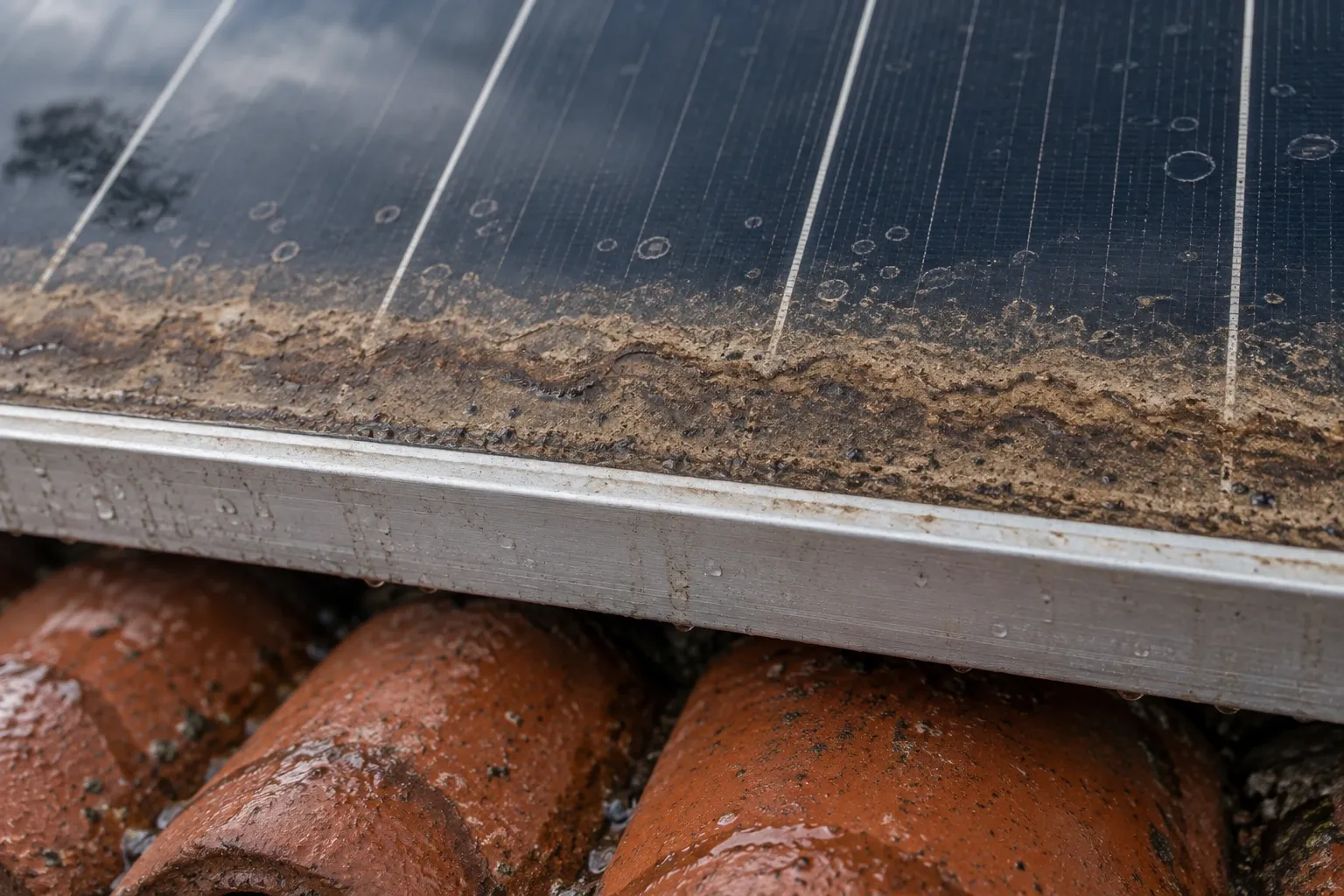
What the rain actually leaves: dirt carried down the glass and dried against the bottom frame. Light rain in particular tends to move soiling to the edge rather than off the panel.
And the winter’s biggest gift disappears quickly. Soiling models assume about two weeks of damp ground after a real soaking before dust starts building again. After the last storm of the season, the clock starts over just as the days get long.
Coachella Valley: the storms mostly hit the mountains
The desert numbers are the part the El Niño headlines leave out. Pacific storms drop most of their moisture on the San Jacinto and Santa Rosa mountains before they reach the valley floor. Thermal’s wettest El Niño winter on record, 1982–83, brought 4.95 inches over six months and five washing-rain days. In 1997–98, the year that flooded coastal California, Thermal got 2.42 inches, almost exactly an average winter.
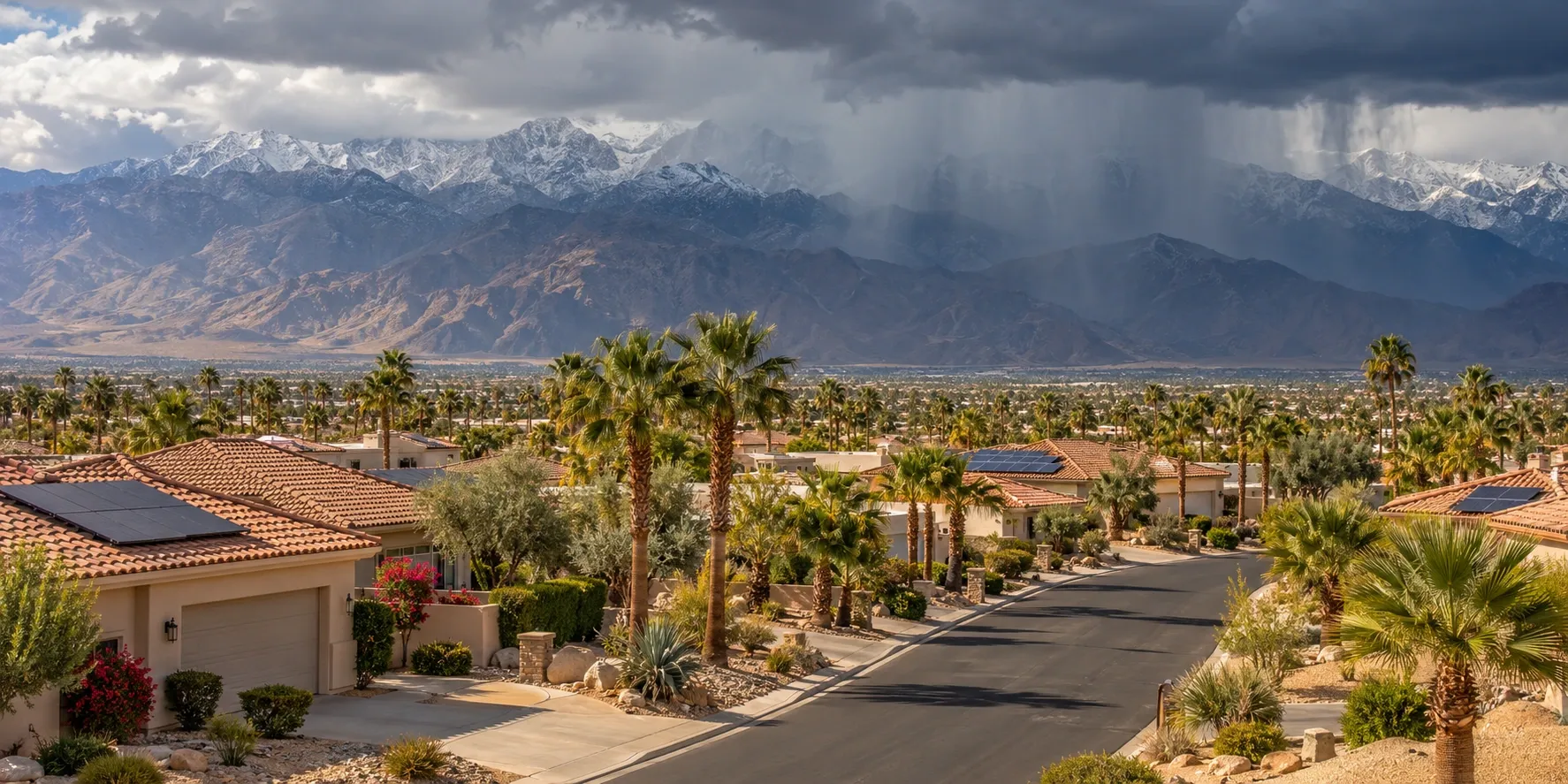
The usual El Niño picture from the valley floor: snow and rain on the peaks, a few scattered showers below.
Three to five washing rains, spread across six months, don’t keep a desert array clean. The dry spells between them are long enough for soiling to rebuild several times over. And the light rain that makes up most desert storm days falls through dusty air and dries on the glass as spots, the same “dirty rain” problem we described in should you clean solar panels before or after a dust storm.
For Coachella Valley owners, an El Niño winter doesn’t change the math. Stay on your normal cleaning cadence, and after any storm that leaves mud spotting, check your panels the same way you would after a monsoon storm.
Your production will drop this winter. Most of it isn’t dirt.
Expect your monitoring app to look worse from November through March, and don’t panic when it does.
Winter output is always lower because the sun sits low and the days are short. El Niño adds clouds on top of that. A 2026 study in Communications Earth & Environment found that El Niño events reduce the sunlight reaching the ground in several solar-heavy regions, California among them. The deficits were largest during super El Niño events, which is what NOAA says we’re heading into.
That creates a real risk of misdiagnosis in both directions. Owners pay for a cleaning when the problem is clouds, or ignore soiling because “it’s just winter.” The fix is to compare clear days only:
- Use the clear day after a soaking rain as your baseline. That’s as clean as the weather is going to get your panels.
- Compare later clear days against it. From the winter solstice on, the sun climbs a little higher every week, so clear-day output should creep up through January, February, and March.
- If clear-day output slides while the days get longer, something is on the glass, or something is wrong with the system.
That last distinction matters. A gradual slide on clear days points to soiling. A sudden drop, a zero reading, or error codes point to equipment, and that’s a call to your installer, not to us.
When to clean during an El Niño winter
Don’t clean right before a storm series. The logic is the same as with a dust storm: you’d pay for clean glass the weather is about to undo. NOAA’s outlook keeps the wet odds highest from December through April, so a cleaning in the middle of that stretch has the shortest shelf life of the year.
Plan the clean that matters for after the storms stop. Your panels earn most of their year’s power from April through September. The clean that pays is the one that removes the winter’s leftovers before those long days start. That means the grime lines, the spotting, and whatever blew in after the last rain.
Don’t wait on anything rain won’t move. Bird droppings, heavy spotting, and debris lying on the array are worth dealing with when you see them, storm season or not.
In the Coachella Valley, keep your normal schedule. The desert’s winter rain isn’t enough to change it.
Stay off the wet roof
Every El Niño winter brings a run of homeowners checking their panels from a ladder after a storm. Wet Spanish tile is slick, it cracks under a misplaced step, and a cracked tile in a rainy winter becomes a leak before anyone notices it. We covered that risk in detail in is drone solar cleaning safe for tile roofs.
Everything in the after-storm check above can be done from the driveway and your phone. When the array does need cleaning, we do it from the ground. The drone does the work over the panels with deionized water, and nobody sets foot on the roof.
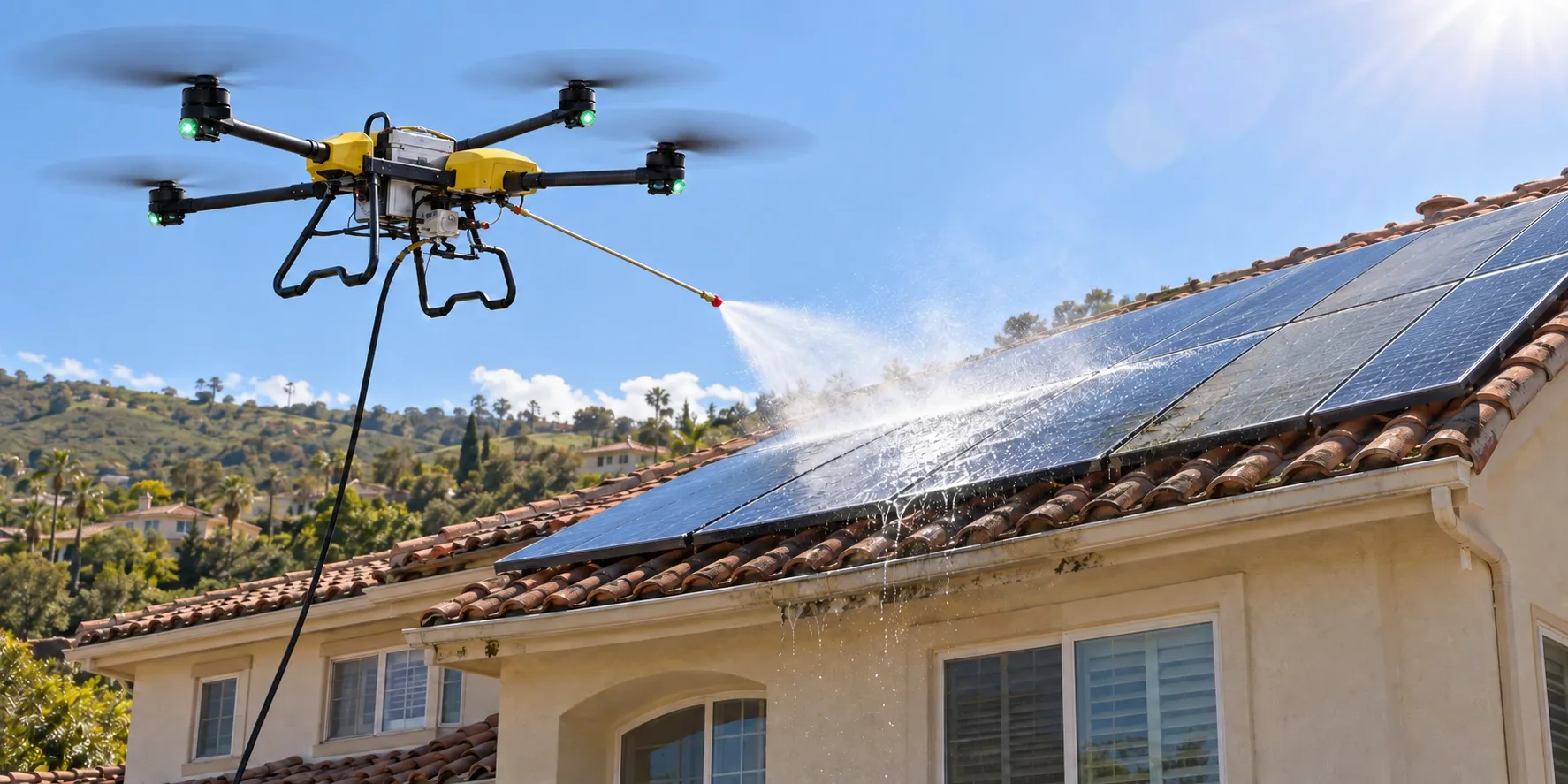
The clean that counts: after the last storm, before the long days. Winter grime comes off and nobody touches the tile.
The short version
A record El Niño is likely this winter, and a wet winter in coastal North County is favored but not guaranteed. If the rain does come, it will rinse loose dust off coastal arrays. It won’t fully clean them, and it won’t touch salt film, bird droppings, or the grime line it leaves along the bottom frame. In the Coachella Valley, even the wettest El Niño on record didn’t bring enough rain to keep panels clean.
Judge your panels on clear days, not cloudy ones. Clean after the storms, not before them. Keep your feet off the wet roof.
If your clear-day numbers are sliding and you want a straight read on whether it’s dirt, send us your address and panel count. If the panels can wait until the storms are done, we’ll tell you that. Residential cleaning runs $9 per panel with a $150 minimum, and the full breakdown is in our cost guide.